
Key takeaways:
Interest in outdoor kitchens is surging as an increasing number of homeowners seek to extend their living space into the backyard.
From custom builds to modular systems, the options for approaching an outdoor kitchen design and build are ever expanding, giving homeowners more flexibility than ever before.
Materials and equipment choices are 2 key decisions that can strongly influence multi-seasonal use and durability.
Southeast Michigan's freeze-thaw climate makes it important for homeowners to explore weather-resistant materials.
Working with an experienced local contractor from design through installation can help protect your outdoor-living investment and its longevity.
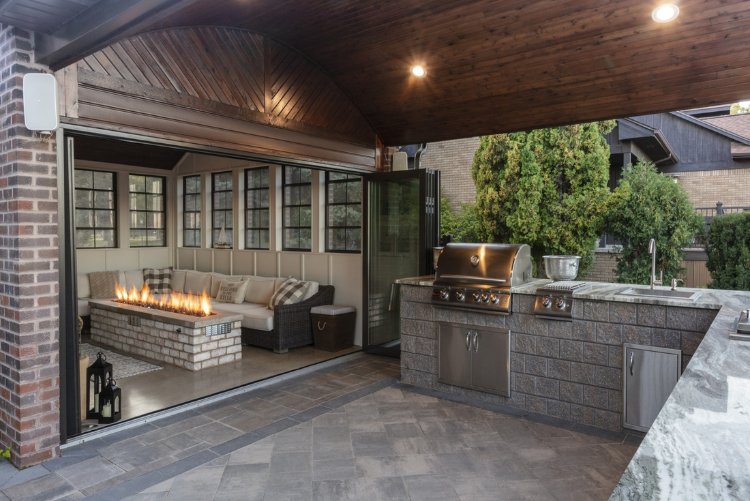
Outdoor kitchens are one of the biggest trends in home improvement, with the market growing at an estimated rate of 8 - 9% annually. And it's easy to see why: More homeowners are treating their backyards as a genuine extension of their living space, and a well-designed outdoor kitchen is often at the center of that evolution.
As summer begins its vibrant descent into fall, homeowners are looking for ways to hold onto the outdoor season just a bit longer. Which is why outdoor kitchens are top-of-mind for many: warm, inviting, and highly functional, an outdoor kitchen provides a delicious reason to linger in the fresh air well past summer's peak.
If you’re ready to start planning, we can point you in the right direction. In Southeast Michigan, however, a successful outdoor kitchen requires more than selecting the right grill, countertop, and cabinets. Drainage, utilities, foundations, material selection, and our freeze-thaw climate all need to be considered as part of the design.
Planning those details from the beginning can make the difference between an outdoor kitchen that simply looks great and one that performs well for years to come.
Planning and Flexibility
Every great outdoor kitchen begins with location and flow.
The ideal outdoor kitchen remains easily accessible from its indoor counterpart, allowing food, drinks, and dishes to move effortlessly between the two while still feeling like a natural extension of the backyard's overall design. Also, consider situating it near an existing patio or seating area, which creates a more seamless flow between cooking and entertaining, rather than two disconnected spaces.
Location is also important. Consider how utilities will reach the kitchen, where water will drain, how smoke from the grill will move in relation to the home and seating areas, and whether the proposed location provides adequate access for construction and future maintenance. These decisions are much easier to address during design than after construction has begun.
Read more >> Create a Home Beyond the Walls: The Perfect Outdoor Kitchen
While Decra-Scape designs and builds some expansive and elaborate outdoor kitchens, we understand that not every homeowner is ready for the works from day one. For families seeking inspiration without an elaborate buildout, there are many great options available.
For example, select a reliable grill and pair it with a compact outdoor refrigerator. For extra function and interactive fun, consider incorporating a more unique cooking element, such as a pizza oven.
Positioning a few food-prep elements near an outdoor dining area can deliver many of the benefits of a full outdoor kitchen without the scope of a custom build.
Read more >> 7 Simple Outdoor Kitchen Ideas for Ultimate Entertaining and Leisure
For homeowners who want flexibility built into the plan from the outset, modular outdoor kitchens deserve serious consideration. These systems can be shaped around the space already at hand, rather than requiring a full redesign of the yard. That adaptability, combined with a faster installation timeline than a fully custom build, make modular options an appealing entry point for many homeowners eager to embrace the outdoor kitchen trend.
Read more >> The Modular Outdoor Kitchen: A Flexible (and Quick) Option
Equipment and Layout
Once your goals are established, the next consideration is what the space will actually hold. This is where layout and equipment decisions come together.
Cooking appliances are typically the starting point, with a quality grill serving as a typical centerpiece, complemented by options like smokers, griddles, pizza ovens, and more. More elaborate setups incorporate traditional kitchen appliances as well: perhaps a sink with disposal, a beverage fridge, a full refrigerator-freezer, or even an outdoor dishwasher. Such additions can allow the outdoor cook to remain outdoors through every stage of meal preparation and cleanup.
Read More >> Create a Home Beyond the Walls: The Perfect Outdoor Kitchen
Storage also deserves attention at this stage. Dedicated, weatherproof storage cabinets built from materials like resin or stainless steel help keep utensils, covers, and tanks protected from the elements while remaining within reach during a cookout. Incorporating storage into your layout from the beginning, rather than adding it as an afterthought, keeps the entire space functioning well for years to come.
Read More >> 6 Outdoor BBQ Storage Solutions for an Organized Outdoor Grilling Space
Materials and Countertops
Materials are where form and function truly converge in an outdoor kitchen, and they're worth getting right from the start, particularly with Michigan winters in the equation.
Countertops are one of the main outdoor kitchen material decisions. Granite and quartzite are two popular natural-stone options, with a wide range of colors, patterns, and finishes available depending on the specific material selected.
But for an outdoor kitchen, appearance shouldn't be the only consideration. Consider the stone, finish, exposure to the elements, maintenance requirements, and ability to perform through Michigan's freeze-thaw cycles.
Read More >> Quartzite Vs. Granite for Outdoor Kitchen Countertops
But the options don’t end there. From concrete to tile, wood to stainless steel and more, you have many looks to consider. Be sure to take all factors into account as you do: study each surface’s durability and maintenance needs, as well as what type of care your selection might require to withstand harsh weather conditions.
Read More >> 7 Stylish and Durable Outdoor Bar Countertop Ideas—Materials & More
And remember, kitchen materials extend beyond the cabinets and countertops to the surface your kitchen sits on. Properly selected and installed pavers are particularly well suited to Southeast Michigan because a segmental pavement system can accommodate seasonal movement while providing a durable, serviceable surface. Individual units can also be removed and replaced if underground utilities ever need to be accessed.
With a wide range of colors, textures and formats available, pavers can also help visually connect the outdoor kitchen to the surrounding patio and landscape. Click here for more about brick pavers.
Ready to Build Your Outdoor Kitchen?
Whether you're ready to begin designing your outdoor kitchen or just beginning to envision what you want in your space, Decra-Scape is here to help. Explore the posts linked throughout this article for a deeper look at each topic, and reach out to our team when you're ready to start planning your own outdoor kitchen.
Outdoor Kitchen Design: Frequently Asked Questions
What are the first decisions you need to make before building an outdoor kitchen?
Begin by identifying what's driving the project and how you envision using the space, whether for everyday cooking, entertaining, or both. From there, consider your must-have equipment, layout, and budget, as these early decisions shape everything that follows in the design process.
What are the pros and cons of modular versus custom outdoor kitchens?
Modular outdoor kitchens are designed to work within the space you already have, offering a faster path than a fully custom build. A custom outdoor kitchen build affords greater design control from the ground up but typically requires more time and construction. For homeowners seeking a quicker route to a finished, tailored space, modular systems have become an increasingly popular middle ground.
How do you choose materials for an outdoor kitchen that can handle weather and seasons?
In a climate like Southeast Michigan, material selection needs to account for freeze-thaw cycles, moisture, temperature swings, and exposure to the elements. Not every product that performs well indoors—or even outdoors in a warmer climate—is necessarily appropriate here.
Look for materials specifically suited to exterior applications and consider not only appearance, but also durability, maintenance, and how each material will interact with the overall construction of the kitchen. Properly selected and installed pavers are an excellent option underfoot because segmental pavement systems are well suited to our seasonal climate.
What's the best countertop material for an outdoor kitchen?
Granite and quartzite are both excellent choices for outdoor use. Granite offers a wider range of colors and patterns, from subtle and uniform to bold and dramatic, making it a popular choice for homeowners seeking design flexibility. Quartzite offers a more consistent look and stands up well to both kitchen heat and Michigan weather. But your options go beyond these 2 popular options. You can explore many countertop options here, but the right choice ultimately comes down to the aesthetic you envision for your space.
What steps should I expect in the outdoor kitchen build process?
At Decra-Scape, our process follows 6 steps:
Discover, where we learn what's driving your project
Define, where we outline the details of your vision
Design, where renderings and drawings bring the concept to life for your feedback
Detail, where specifics and timelines are finalized
Deliver, where materials are procured and construction begins
DSI Care, our ongoing maintenance support following the build's completion
The contractor you choose should have an equally detailed and well-defined process already established.
How do I select the best outdoor kitchen contractor?
Look for proper Michigan licensing and active insurance, genuine experience with local soils and freeze-thaw seasons, and a written estimate that clearly outlines materials, labor, and timeline rather than a single vague figure.
A strong contractor will also have a portfolio of local projects and references you can contact directly, and should communicate clearly and responsively before you ever sign an agreement. For a project involving an outdoor kitchen, also ask who is responsible for coordinating the entire outdoor environment, not just the kitchen itself.
Grading, drainage, utilities, paving, structures, and surrounding landscape elements should work together as one system. A contractor who understands how those pieces interact can identify potential conflicts during design rather than discovering them during construction.
