
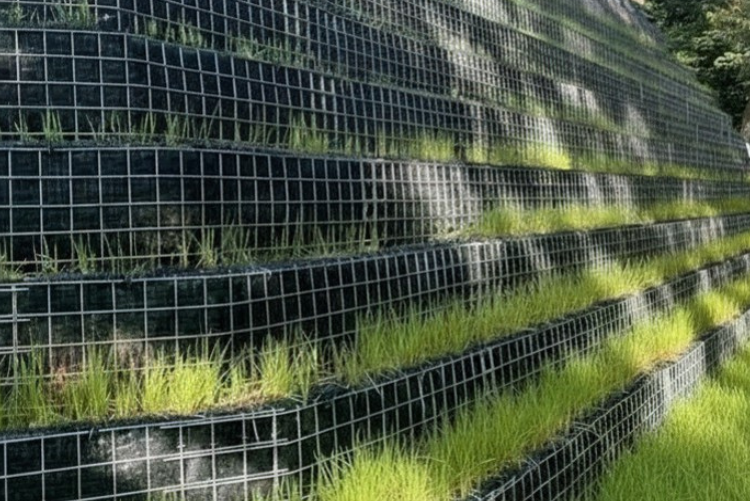
Decra-Scape was recently featured in CAM Magazine for its role in delivering a reinforced soil slope live wall system at the University of Michigan Child Care Center. The article highlights the growing role of these systems in modern site development.
While that project was commercial in scale, the principles behind it are increasingly relevant for residential properties, especially where grade, drainage, and long-term performance all need to be considered together.
Every outdoor space is shaped by a combination of structure and environment. In some cases, that means solving for grade changes, drainage, or stability. In others, it means creating something that feels natural, integrated, and built to last.
Increasingly, homeowners are asking if they can do both at the same time.
What Is a Living Wall?
A living wall is a type of retaining system that supports soil while also allowing vegetation to grow directly within the structure itself.
Unlike traditional block retaining walls, which present a hard, uniform face, a living wall evolves over time. As vegetation establishes, the wall begins to blend into the surrounding landscape, creating a softer and more natural appearance.
But this is not simply a visual upgrade. When designed and installed correctly, living walls can:
Help manage stormwater more effectively when properly designed
Reduce surface heat buildup compared to hardscape surfaces
Support plant life and local ecosystems when vegetation is established
Integrate more naturally with surrounding grades and plantings
To better understand how this compares to more traditional approaches, it helps to look at the differences side by side.
A Practical Comparison for Michigan Conditions
| Attribute | Living Wall System (Reinforced Soil + Vegetation) | Traditional Retaining Wall (Concrete / Block / Stone) |
|---|---|---|
| Initial Cost | Higher up-front cost due to engineered system, planting, and drainage integration. Typically exceeds standard wall pricing. | Variable but generally lower up-front cost per sq. ft. in SE Michigan, depending on material and site complexity. |
| Maintenance Requirements | Moderate: vegetation establishment, seasonal trimming, and irrigation monitoring early on; stabilizes over time as plants mature. | Low to moderate: periodic inspection for cracking, drainage issues, and joint repair. |
| Lifespan | 50+ years when properly engineered and maintained (structure); vegetation evolves continuously over time. | 50 - 100+ years for concrete/stone systems, depending on materials and installation quality. |
| Environmental Impact | Positive when properly designed: can support biodiversity, reduce heat island effect, and improve stormwater absorption. | Neutral when built with permeable materials and integrated landscaping. |
| Aesthetic Evolution | Dynamic: becomes more natural over time as vegetation matures and fills in. | More static: appearance remains largely unchanged after installation. |
| Drainage Performance | High when properly designed: manages water through soil mass and planted face, helping reduce runoff pressure. | Moderate to high: depends heavily on installed drainage systems (weep holes, backfill, drains, materials, etc.). |
| Freeze-Thaw Resilience | High when engineered correctly; flexible system can accommodate movement and settlement. | Varies by material: rigid systems (poured concrete) are more prone to cracking under freeze-thaw stress. |
| Response to Michigan Climate | Flexible structure can help absorb movement from clay soils and freeze-thaw cycles when properly engineered. | Requires precise materials, base prep, and drainage to avoid cracking, shifting, or heaving. |
| Installation Timeline | Longer: requires structural build, planting phase, and establishment period. | Shorter: standard systems can be installed relatively quickly, depending on size and access. |
| Long-Term Performance in Michigan | Strong when properly designed and installed: combines structural support with environmental adaptability, especially in moisture-heavy conditions. | Strong when properly designed and installed; performance depends heavily on drainage, base prep, and material selection. |
Where Living Walls Make Sense in Residential Projects
Not every property requires a system like this. But in the right conditions, it can be a strong fit. We typically see interest in living walls when:
There are significant elevation changes across the property
A traditional retaining wall would feel too rigid or dominant
The goal is to create a more natural, landscape-forward environment
Drainage and long-term performance are key concerns
In these situations, the question becomes less about “can we hold this grade?” and more about how that solution integrates into the space long-term.
Where Living Walls May Not Be the Right Fit
While living wall systems offer a unique combination of structure and landscape integration, they are not the right solution for every property.
In residential settings, they are typically considered only in more complex site conditions. Situations where a traditional retaining wall may be more appropriate include:
Smaller yards with limited space or tighter budgets
Clients who prefer low-maintenance landscapes or are unwilling to maintain vegetation
Simple grade changes, particularly under 3 - 4 feet in height
Projects where speed of installation is a primary concern
In these cases, a well-built traditional retaining wall can often provide a more practical and cost-effective solution.
The key is aligning the system with the property conditions and the homeowner’s expectations over time.
The Structural Side (Simplified)
Behind the planted face, a living wall is still a highly engineered system.
It relies on reinforced soil, internal support layers, and careful installation to ensure long-term stability. The visible greenery is only one part of what makes the system work.
For most homeowners, the technical details are less important than the outcome: a structure that performs reliably without feeling overly built or out of place.
That said, proper design and installation are critical. Systems like these require a clear understanding of soil conditions, drainage, and load requirements to perform as intended over time.
A Recent Example in Practice
This approach was recently highlighted in a commercial project at the University of Michigan Child Care Center, where a reinforced soil slope live wall system was installed as part of the site development, with Decra-Scape leading the wall installation.
The project was featured in CAM Magazine’s 2026 Green Issue, recognizing both the structural performance of the system and its ability to function as a living landscape rather than a traditional retaining wall.
While that project was commercial in scale, the principles behind it carry over. The same balance of structure, flexibility, and environmental integration is what makes living wall systems increasingly relevant in residential settings.
Why This Matters for Homeowners
In Michigan, outdoor spaces are exposed to freeze-thaw cycles, shifting soils, and long-term wear. Any retaining solution needs to account for those realities.
Living wall systems offer an interesting alternative to conventional approaches by combining:
Structural reliability
Environmental performance
A more natural, evolving appearance
As Matt Caruso, owner of Decra-Scape, notes, “What makes this system powerful is its ability to combine structural integrity, long-term value, and environmental stewardship in one solution.”
Moving Forward
Proper evaluation early in the process is critical to determining whether this type of system is the right fit.
At Decra-Scape, the focus is always on aligning the solution with the property, the environment, and how the space will be used over time.
If you are evaluating options for a property with grade challenges or looking for an approach to retaining structures that brings an organic appeal, it’s worth understanding what systems like this can offer. Contact us with questions today.
For more inspiration, check out our gallery of our work, read more on the blog, or catch up with us on Instagram.
